The Filipino who shaped the Digital World
As you read this article on a smart phone or any digital device, know that you are using technology influenced by Diosdado Banatao.
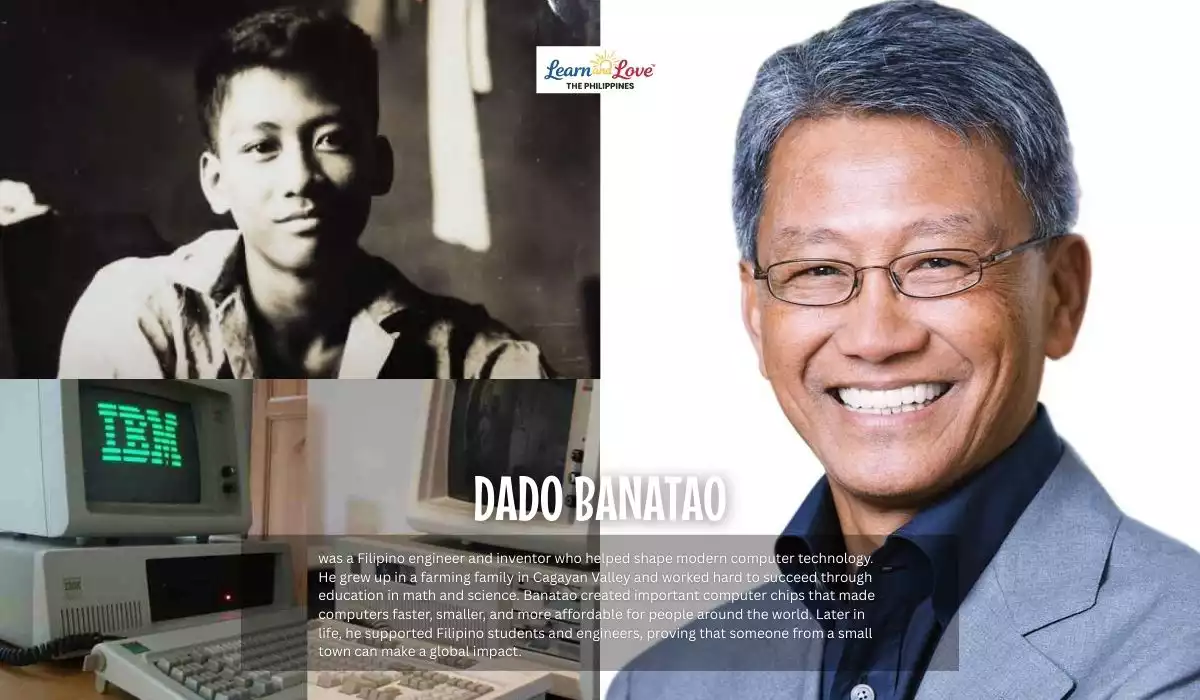
Also known as “Dado,” Banatao (May 23, 1946 – December 25, 2025) was an engineer, inventor, entrepreneur, aviator, and philanthropist, who helped build the foundations of digital technology, playing a key role in what we now experience through our personal computers and devices.
The Simple Beginnings of Diosdado Banatao
Dado Banatao was born in Malabbac, Iguig, a quiet farming community in Cagayan Valley, Region II. His father earned a living as a rice farmer, while his mother worked as a housekeeper. Life was modest and often challenging.
As a child, Dado sometimes walked to school without shoes. He did not have access to modern tools or comfortable classrooms, but he grew up in a home that believed learning was the path to a better future.
Dado often said that his father was his greatest role model. Although his father lived a simple life, he worked tirelessly to make sure his children could study. Seeing his father push through hardship taught Dado the importance of persistence.
From a young age, he understood that real success comes from effort, patience, and refusing to give up.
Joy in Learning
While in school, Dado developed a strong interest in math and science. These subjects were demanding, but he enjoyed the challenge of solving problems and understanding how things worked. His teachers encouraged careful thinking and curiosity. These habits later became essential to his work as an engineer.
For Dado, learning was not just about passing exams. It was about gaining skills to solve problems around him and make this world a better place to live in—one of the key traits of every successful entrepreneur.
As his education continued, Dado eventually moved to the United States because of limitations in what the Philippine education of his time could offer. There, he entered a highly competitive environment filled with new ideas and inventions. This place later became known as Silicon Valley, the birthplace of many major technology companies.
The pace was fast, and only strong ideas survived. Dado knew that success in this world required discipline, creativity, and relentless effort.
How Diosdado Banatao changed computers
During the mid-1980s, Dado introduced an invention that transformed personal computers. At the time, computers were bulky, slow, and costly because they relied on many separate chips. Instructions you give the computer need to be typed through the keyboard.
Dado’s innovation greatly sped up how computers handled images, helping move technology from simple text screens to visual interfaces like Windows, and making computers easier to use and more affordable for people.
Dado invented the first Ethernet chip and GUI accelerators. While working at Seeq Technology, he developed the first 10-megabit Ethernet CMOS chip with integrated data-link control and transceiver functions. He later designed the first system logic chipsets for IBM’s PC-XT and PC-AT, along with one of the earliest graphics accelerators that enabled graphical user interfaces on personal computers.His system logic chip set successfully combined several functions into fewer parts. His breakthrough innovation made computers more efficient and affordable, allowing schools, offices, and households to use them more easily.
Dado’s work did not stop with computer speed and size. He also helped develop graphics accelerator chips that improved how images appeared on screens. These chips allowed clearer pictures and smoother motion. Today’s videos, games, and digital images are better because of ideas he helped introduce many years ago.
Banatao's global impact
As an entrepreneur, Banatao helped build several highly successful startups, including Mostron, Chips and Technologies, and S3 Graphics.
In 1984, he co-founded Mostron, a company that manufactured computer motherboards. The following year, he helped establish Chips and Technologies, where he led the development of the chipset used in IBM’s PC-XT and PC-AT computers.
In 1989, he founded S3 Graphics, a company dedicated to advancing personal computer graphics through accelerator chip technology.
By 2000, Banatao had launched his own investment firm, Tallwood Venture Capital. In 2010, he served as chief executive officer of Ikanos Communications and was also involved with SiRF Technology Inc., a company that helped bring GPS technology into everyday consumer devices.
Staying Grounded Despite Success
Successful entrepreneurs don’t forget where they started. Even after reaching great heights in his career, Dado remained modest. He never forgot his upbringing or the struggles he faced as a child.
To him, success was not measured only by money or recognition. He believed true success included lifting others and creating opportunities. He often emphasized that discipline, clear thinking, and courage were necessary to survive in the technology world.
Those who worked with Dado described him as calm, focused, and respectful. He rarely talked about his achievements. To his wife, Maria, he was a sincere and straightforward man.
To young inventors and students, Dado was proof that someone from a small rural town could reach the highest levels of global success.
Diosdado Banatao's Love for the Philippines
Despite living in the United States, Dado still longed for his home country to prosper. In his later years, Dado turned his attention to helping Filipinos, especially students and engineers. He founded the Philippine Development Foundation, the Dado Banatao Educational Foundation, and the Banatao Filipino-American Fund.
Dado also served as the founder and managing partner of the highly successful Silicon Valley firm Tallwood Venture Capital.

Through the Dado Banatao Educational Foundation, Dado helps support future engineering scholars. Through the Philippine Development Foundation, he makes quality education accessible to young Filipinos. In his hometown, he established a computer center in his former grade school.
He also supports Filipino-American high school students in Northern California who aspire to become engineers through the Banatao Filipino-American Fund.
As a dedicated pioneer, Dado earned the prestigious Ellis Island Medal of Honor, given to outstanding U.S. citizens, and was later appointed by the Philippine government as the country’s first Special Envoy for Science and Technology.
The legacy of Diosdado Banatao
Diosdado Banatao passed away on Christmas of 2025 at the age of 79. Despite his departure, his legacy remains strong. His inventions continue to support modern computing at a global stage. His dedication to education continues to shape future engineers. Above all, his story continues to motivate people around the world.
Dado Banatao once said:
“My success is a direct result of my beginnings. It is the same will and determination that every Filipino possesses. There are countless kids who just need a chance like I did. I am not so special, but I am determined.”
Indeed, the most important lesson from Dado Banatao’s life goes beyond technology. His story is about bravery, perseverance, and taking chances. He showed that starting with little does not limit how far a Filipino can go. With determination, learning, and courage, even a child from a remote province in the Philippines can help shape the future.